

Every CTO has faced this moment. The product roadmap is locked, timelines are tight, and the team is ready to move. Then someone asks a question that sounds simple on the surface: “So… are we going with React or Vue?”
In 2026, this choice is far from straightforward. What looks like a technical preference quickly becomes a long-term business decision. Selecting the Best Frontend Framework today directly impacts how fast your team can build, how easily you can hire developers, how much maintenance will cost, and how smoothly your product will scale over the next few years. It also influences developer morale and the speed at which new features reach users.
When it comes to React vs Vue.js for web development, both frameworks are mature, reliable, and widely adopted. They power startups, SaaS platforms, and some of the world’s largest enterprise applications. Yet, they solve problems in different ways. React offers flexibility and a massive ecosystem, making it popular for complex products, while Vue focuses on simplicity and a developer-friendly structure that speeds up development.
This guide is not about trends or hype. It’s about understanding what truly matters when choosing the Best frontend framework for enterprise and long-term growth in 2026, so your decision supports both your product vision and your business goals.
The Frontend Landscape in 2026
Frontend development in 2026 is very different from what it was a few years ago. Today’s applications are faster, more interactive, and expected to work smoothly on all devices and in all regions. Users want websites and apps to load instantly, feel smooth while using them, and offer experiences that feel personal.
A few major trends are shaping frontend development right now:
- Server-side rendering and edge computing are commonly used to improve speed
- AI-based developer tools help teams write code faster and better
- Performance and Core Web Vitals affect both SEO rankings and user engagement
- Design systems and reusable components are now standard for most teams
Because of this, choosing the Best frontend framework 2026 is not just about building user interfaces. The framework must also support easy scaling, strong security, and simple long-term maintenance.
Even though many new tools have appeared, React and Vue.js continue to lead the frontend space. They keep improving and adapt well to modern development needs and enterprise requirements. For CTOs, this makes them reliable choices that reduce risk and support long-term business goals.
React in 2026: Current State and Maturity
In 2026, React is a stable and well-tested frontend framework. It has grown far beyond being just a simple UI tool. Today, React is used to build complex applications for global enterprises, SaaS products, and websites with very high traffic.
One of React’s biggest strengths is flexibility. It does not force teams to follow strict rules. This allows developers to design the application structure based on their product needs. With features like React Server Components, better rendering methods, and strong support from frameworks such as Next.js, React delivers strong performance and scales well as products grow.
React also has one of the largest ecosystems in frontend development. There are ready-made libraries for almost everything, including state management, animations, testing, security, and performance improvement. This makes React a safe and reliable option for long-term projects.
From a business point of view, React is widely adopted and strongly supported. Developers are easy to find, and companies can hire React developers in India at competitive rates. Documentation is detailed, and community help is extensive. This is why many companies still see React as the Best frontend framework for enterprise applications.
Vue.js in 2026: Where It Stands Today
Vue.js has grown steadily over the years and is now a strong framework in its own right. By 2026, it is no longer viewed as just an alternative to React. Vue is widely used by startups, growing businesses, and even large organizations.
Vue’s biggest strength is its simplicity. It is easy to learn, especially for teams familiar with HTML, CSS, and JavaScript. The Composition API has become stable and helps developers manage large applications while keeping the code clean and readable.
Vue’s ecosystem has also improved a lot. Tools like Nuxt, Vite, and Pinia help teams build applications faster and in a more organized way. Vue projects are often known for clean structure and predictable behavior.
For CTOs who care about quick onboarding and happy development teams, companies can hire Vue.js developers in India. Vue.js is a strong option for teams that want high productivity without dealing with complex architecture decisions.

Performance and Scalability
1. Runtime Performance (High-Level View)
React:
React delivers strong runtime performance, especially in complex applications. With modern updates like improved rendering and better scheduling, React handles frequent UI updates smoothly. Performance depends largely on how well components are designed and optimized.
Vue.js:
Vue is known for efficient rendering due to its reactive system. It updates only the parts of the UI that change, which helps maintain smooth performance. In most real-world cases, Vue feels fast without needing heavy optimization.
2. Bundle Size and Load Optimization
React:
React apps can have larger bundle sizes if not optimized. However, modern build tools and frameworks help reduce load size through code splitting and lazy loading. With proper setup, React applications can load quickly even at scale.
Vue.js:
Vue usually has a smaller bundle size by default. This can result in faster initial page load, especially for smaller or medium-sized applications. Less configuration is often needed to achieve good load performance.
3. Server-Side Rendering and Hydration Costs
React:
React supports server-side rendering through popular frameworks. While SSR improves load speed and SEO, hydration can be resource-heavy if not handled carefully. Proper implementation is important to avoid delays after page load.
Vue.js:
Vue also supports server-side rendering and handles hydration efficiently. Its simpler structure often makes SSR easier to manage, reducing the risk of performance issues during client-side takeover.
4. Scalability for High-Traffic Enterprise Applications
React:
React is widely used in large enterprise systems and high-traffic platforms. Its flexibility allows teams to design scalable architectures that handle complex data flows and heavy user traffic effectively.
Vue.js:
Vue scales well when teams follow its recommended patterns. While it may be less common in massive enterprise systems, Vue performs reliably in growing applications and handles increasing traffic smoothly.
5. Performance Tuning and Monitoring Ecosystem
React:
React has a large ecosystem of tools for performance monitoring, error tracking, and optimization. This makes it easier to identify issues and fine-tune applications over time.
Vue.js:
Vue also offers strong tools for monitoring and debugging. While the ecosystem is smaller, it covers most needs and is easier to use for teams that prefer simplicity.
6. Real-World Performance Beyond Benchmarks
React:
In real projects, React performance depends heavily on code quality and architecture. With proper best practices, React applications can perform extremely well even at large scale.
Vue.js:
Vue often delivers good real-world performance with less effort. Its clear structure helps teams avoid common mistakes that can slow down applications.
Developer Experience and Productivity

1. Learning Curve for Developers
React:
React has a moderate learning curve. New developers often need time to understand concepts like state management, hooks, and component structure. Experienced developers enjoy the flexibility, but beginners may feel overwhelmed at first.
Vue.js:
Vue is easier to learn, especially for developers familiar with HTML, CSS, and JavaScript. Its syntax feels natural, which helps new developers become productive quickly.
2. Code Readability and Maintainability
React:
React code can look very different across projects because teams make many architectural choices. With good standards, React apps are easy to maintain, but without discipline, codebases can become hard to manage.
Vue.js:
Vue promotes cleaner and more consistent code. Its clear structure helps teams keep code readable, even as the application grows. This makes long-term maintenance easier.
3. Tooling, Debugging, and IDE Support
React:
React has a very large set of tools for debugging and testing. IDE support is excellent, and developers have many options for performance analysis and error tracking.
Vue.js:
Vue also offers strong development tools that are simple to use. Debugging is straightforward, and its official tools cover most common needs without extra setup.
4. Integration with AI Coding Assistants
React:
React works very well with AI coding tools. Due to its large ecosystem and documentation, AI assistants can easily suggest code, fix issues, and speed up development.
Vue.js:
Vue also integrates smoothly with AI tools. Its simpler structure often results in cleaner and more accurate AI-generated suggestions.
5. Speed of Development and Iteration
React:
React allows fast development once the architecture is set. However, initial setup and decisions can slow down early stages of development.
Vue.js:
Vue enables faster development from the start. Teams can build features quickly with fewer decisions, making it ideal for rapid iteration.
6. Impact on Team Velocity and Morale
React:
React teams move fast when they are experienced and well-aligned. However, complexity can sometimes affect team morale if standards are unclear.
Vue.js:
Vue often leads to higher team satisfaction. Its simplicity reduces frustration and helps teams stay productive and motivated.
Hiring, Talent Availability, and Cost Implications
React talent pool in 2026
React has a very large number of developers across the world. It is easy to find experienced React developers and scale teams quickly. Many companies choose to hire React developers in India because talent is easily available and cost-effective.
Vue.js developer availability globally
Vue.js has fewer developers compared to React, but the number continues to grow each year. For companies looking to expand their teams, it is possible to hire Vue.js developers in India, although it may take slightly longer than hiring React developers.
Hiring timelines and salary
React developers are easier and faster to hire. Salaries can be slightly higher in competitive markets, but options across regions help manage costs. Vue developer roles may take longer to fill, but salary expectations are often reasonable.
Upskilling existing teams
Vue.js is easier to learn for most developers, especially those who know basic web technologies. React usually needs more learning time and practice.
Long-term development cost
React reduces risk because replacing or adding developers is easier. Vue can reduce costs by keeping code simple and easier to maintain.
Vendor or skill lock-in risk
Both React and Vue.js are open-source and widely used. There is very little risk of being locked into one vendor or skill set.
Ecosystem, Community, and Long-Term Support
Third-Party Libraries and Integrations
React has one of the largest ecosystems in frontend development. There are libraries available for almost every use case, including UI components, charts, forms, testing, and security. This gives teams more flexibility when building complex applications.
Vue also has a reliable ecosystem, but it is smaller. Most Vue libraries are well-maintained and easy to integrate, which helps teams avoid confusion and unnecessary complexity.
Enterprise-Ready Tooling and Plugins
React is widely used in enterprise projects, so many tools are designed specifically for large and long-running applications. These tools help with performance, monitoring, testing, and scaling. Vue supports enterprise development as well, mainly through official tools that focus on simplicity and stability. While options may be fewer, they are often easier to manage.
Community Health and Innovation
React has a very large and active global community. New ideas, tools, and improvements appear quickly, helping teams stay up to date with modern practices.
Vue’s community is smaller but highly focused. Updates are more steady and carefully planned, which reduces unexpected changes.
Governance and Long-Term Stability
React benefits from strong corporate backing, which gives confidence in long-term support and roadmap planning. Vue follows a more independent and community-driven governance model, which appeals to teams that value flexibility and open development.
Updates, Breaking Changes, and Longevity
Both frameworks handle updates carefully. Breaking changes are rare and clearly documented. React and Vue.js are both actively maintained, making them safe and reliable long-term investments.
Security, Compliance, and Enterprise Readiness
Security Practices and Tooling
Both React and Vue.js allow teams to follow strong security practices. Developers can use trusted tools and libraries to protect applications from common threats such as data leaks or unauthorized access.
Authentication and Access Control
Both frameworks work well with modern authentication systems. Features like secure login, role-based access, and user permissions can be implemented without difficulty.
Compliance and Regulations
React and Vue.js can support compliance requirements such as GDPR, SOC 2, and HIPAA. Compliance depends more on how the application is designed rather than the framework itself.
Stability for Regulated Industries
Both frameworks are suitable for regulated industries like finance, healthcare, and enterprise SaaS. With proper processes and testing, they provide stable and secure foundations.
Risk Management for CTOs
From a CTO’s perspective, both React and Vue.js are low-risk choices. They are widely adopted, well-supported, and continue to evolve, making them reliable options for long-term enterprise projects.
Use-Case Based Recommendations
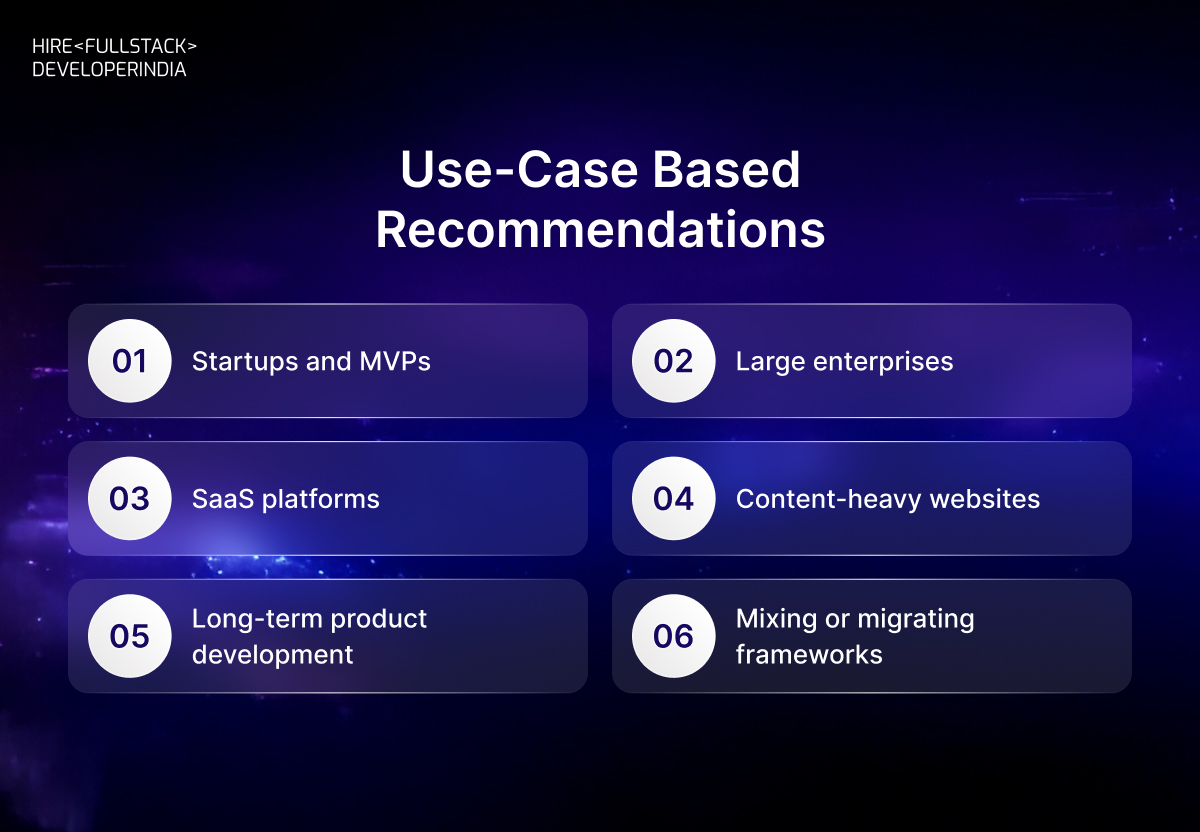
Startups and MVPs
Vue.js is often a better choice because it is easy to learn and quick to build with. React also works if the team already knows it.
Large enterprises
React is usually preferred for complex systems, multiple teams, and long-term scalability.
SaaS platforms
Both React and Vue.js work well. React suits fast-growing and feature-rich SaaS products, while Vue is good for simpler, clean, and fast development.
Content-heavy websites
Both frameworks support SEO and fast loading. Vue is good for simpler content sites, while React fits content platforms with advanced features.
Long-term product development
React offers long-term stability due to wide adoption. Vue is also reliable and easier to maintain for structured teams.
Mixing or migrating frameworks
Migration makes sense when products grow or requirements change. Both React and Vue allow gradual migration with low risk.
React vs Vue.js: Quick Comparison
Which One Should You Choose?
Choosing between React and Vue.js in 2026 depends on your team, product goals, and long-term plans. There is no one-size-fits-all answer, but a few simple guidelines can make the decision easier.
Choose React if you are building a large or complex product, expect high traffic, or plan to scale your team quickly. React is a strong option for enterprises that need flexibility, deep integrations, and easy access to global talent. It is also a safer choice when long-term stability and hiring speed are top priorities.
Choose Vue.js if you want faster development, easier learning, and a clean code structure. Vue works well for startups, MVPs, and teams that value simplicity and productivity. It is a good fit when you want to reduce development complexity and onboard developers quickly.
In short, React is best when scale and flexibility matter most, while Vue.js is ideal when speed, clarity, and ease of use are more important. The right choice is the one that aligns with your business goals and team strengths.
Conclusion
At the end of the day, choosing between React and Vue.js in 2026 is not about which framework is “better.” It’s about which one fits your team and your product the best.
React makes sense when you are building something big, complex, and meant to scale for years. It gives you flexibility, a huge ecosystem, and easy access to developers. If hiring speed, long-term growth, and enterprise-level needs are high on your list, React is a safe and proven choice.
Vue.js shines when you want things to stay simple. It helps teams move faster, write cleaner code, and avoid unnecessary complexity. For startups, MVPs, or teams that want quick results without heavy setup, Vue can feel more comfortable and efficient.
Both frameworks are strong, reliable, and future-ready. You won’t go wrong with either if the decision is made thoughtfully. The best choice is the one that supports your goals today and still makes sense a few years down the line.